

What is Card-Linked Marketing?
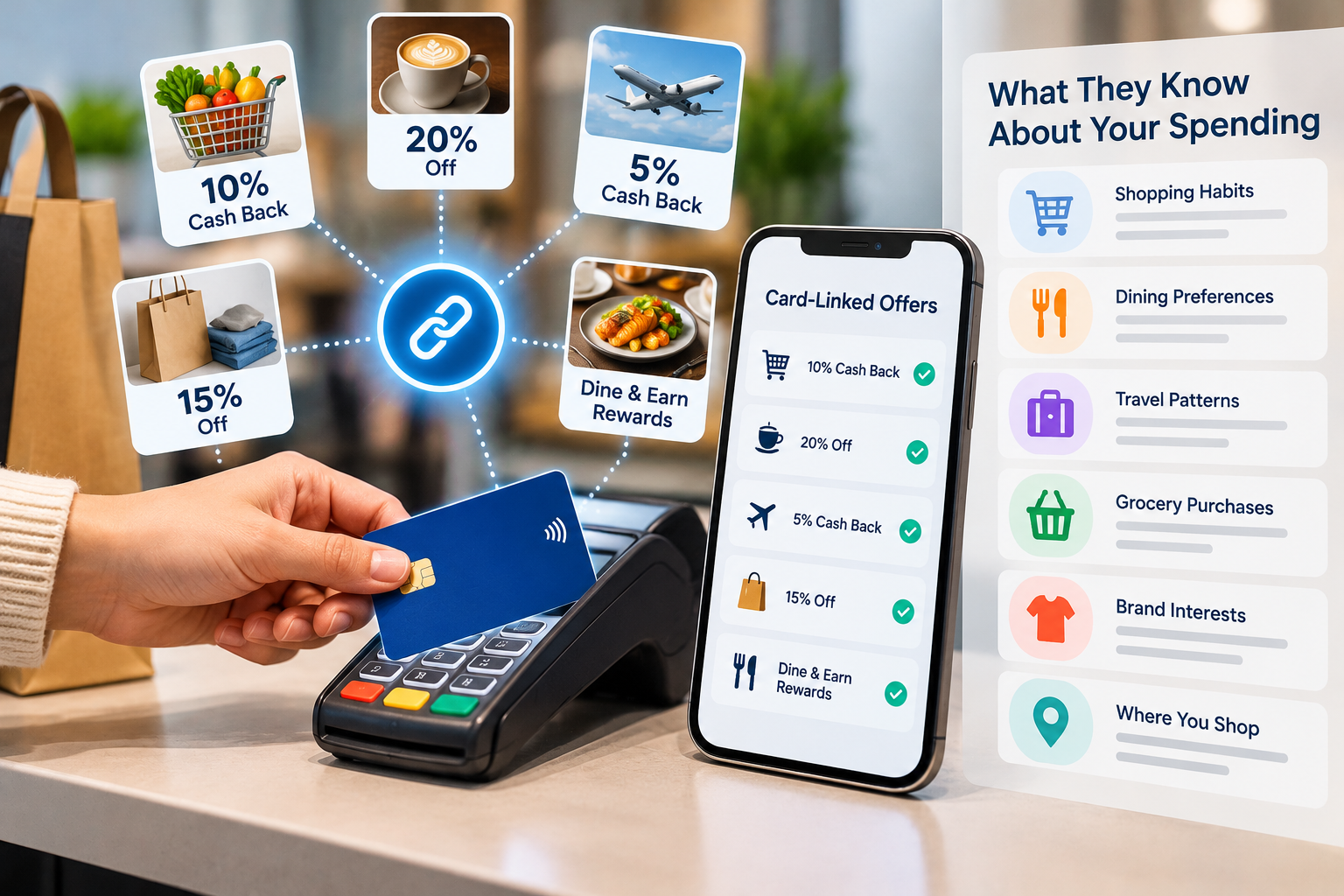
Card-linked marketing (CLM) is a digital advertising and loyalty tool, usually executed through card-linked offers (CLOs). Consumers can find CLOs directly on their credit or debit card as discounts, rewards, cashback, and other connected digital offers from brands.
There are three main categories of CLM platforms:
- bank/issuer-led
- standalone CLM apps
- aggregators
Examples from each category appear below.
Card-linked marketing is the overall strategy, while card-linked offers are individual promotions. CLOs are part of a card-linked loyalty program, which comprises the entire infrastructure.
How it Works
No standard body, like the Consumer Financial Protection Bureau, defines card-linked offers. Their latest Credit Card Rewards issue spotlight (May 2024) doesn’t mention card-linked offers, third-party offer networks, or merchant-funded rewards. It only covers credit card rewards and sign-up bonuses offered when you open a new card.
Any available definition is an industry one. Here is how it works in practice:
- Register: you link your card to the rewards platform.
- Discover: browse for eligible offers from merchants.
- Shop: complete the qualifying purchase online or in physical stores using the linked card.
- Earn: get your reward.
The key point is that the card serves as both the payment instrument and the loyalty identifier.
For example, you open your preferred banking app and see a cashback reward if you use your card to complete the transaction. You need to follow the link in your banking app to reach the merchant’s platform. Once the transaction is processed, which can take several days, you’ll see the cashback in your banking app. It’s money you earned, and you can spend it however you want. This example falls into the bank-led CLO category.
Some providers work directly with banks, like Cardlytics, whose 2021 acquisition of Dosh extended its reach into neobanks and fintech apps such as Venmo. Others are standalone platforms consumers link to directly, such as Rakuten’s in-store cashback or Upside.
Advantages and Disadvantages for Consumers
The main advantage of card-linked offers for the consumer is that you don’t need to show a loyalty card. You can access a wide range of perks with your debit or credit card. It’s a seamless experience because you encounter less friction before you get your reward.
The offers are also relevant, since they are personalized based on your consumer behavior, and they use strict privacy protections, such as anonymization, and an opt-out feature. Transactions are usually protected by the same systems used for bank payments.
If you want to be extra cautious with your card and personal information, you can choose merchants or card-linked offer platforms that partner with FDIC-insured banks. Plus, they need to disclose their security measures and use PCI DSS (Payment Card Industry Data Security Standard), a set of global security rules for companies that store, process, or transmit credit card information.
You can also use merchant or network aggregators to reduce the number of apps or platforms you need to manage, such as Figg, Kard, or Pro loyalty networks. These are also called white-label network aggregators.
Disadvantages include providers and financial institutions collecting, storing, and tracking your data to analyze your consumer behavior and issue personalized offers. You’re also trading some of your time in the process. Although you don’t have to carry paper coupons or physical loyalty cards, you still need to take a few steps before getting rewarded, as shown above.
How Financial Institutions Use Your Purchase History to Serve Personalized Discounts
The process is far more complex for the financial institutions and merchants involved in the card-linked loyalty architecture, typically banks, retailers, and technology providers. Beyond enrolment and payment, several more operations happen in the background, from the CLO provider’s perspective: acquire, surface, match, qualify, calculate, and deliver. In simple terms, though, the parties communicate continuously to formulate, test, and deploy offers that work.
The eight steps of the card-linked loyalty architecture look something like this:
- Enrol – the consumer links the card to the rewards platform.
- Pay – the consumer shops at the registered merchant with the linked card.
- Acquire – the financial institution submits the transaction made by the consumer.
- 4. Surface – the transaction information reaches the platform.
- Match – matching the cardholder to a specific transaction and the merchant location.
- Qualify – the process of deciding whether the transaction meets the reward criteria.
- Calculate – the program calculates the exact value of the reward.
- Deliver – the program sends the reward and informs the cardholder (i.e., cashback, points, etc.).
CLO providers collect data, such as transaction value, date, merchant, and location. PushNotice cites Mastercard’s loyalty and rewards privacy notice, as of 9 February 2026, which states that it collects “the date/time of the payments, personal account number, name of merchant, commercial and transaction code, currency and amount of a purchase, and a tokenized ID generated to identify whether the purchase is eligible for the program.” Card numbers are not stored, and developers see only the first six and last four digits.
The data is then anonymized and aggregated, so retailers don’t receive your personal information. However, they can use it to understand your consumer behavior.
Payment data shows which retailers you purchase from, how often you visit, your average spend across the market – not just with one retailer, how you respond to incentives, and the exact moment when you stop visiting.
Generative AI-driven Shopping Agents
The 2026 Cardlinx survey showed that emerging digital commerce technologies are shared among AI agents (56%), other AI technology (i.e., bots) (34.7%), peer-to-peer payments (4%), and super apps (5.3%). Agentic AI creates hyper-personalized CLO ecosystems in which agents actively negotiate, search for the most suitable offers, and transact on behalf of consumers. AI platforms have generated strong competition between CLO models and digital wallets or open banking.
The gap between technological capabilities is widening due to AI and consumer trust in data privacy. While data is more granular, infrastructure and regulation are lagging.
How to Opt Out from Card-Linked Offers?
When you register your card with a rewards program, you consent in the terms and conditions to have transactions on that card monitored. If you don’t register your card on standalone CLM apps, you can avoid that monitoring. This doesn’t apply, though, if you still need to use digital banking apps or merchant aggregators for anything non-CLO. Even if you don’t register for specific offers on these platforms or apps, being on them means you’re being monitored.
If you’d rather not be tracked that way, you can opt out of CLOs by managing the platform settings. In your digital banking app, you can turn off card-linked promotions. For third-party merchants, you can usually find these under Account Settings, Linked Cards, or Payment Methods, where you can unlink or delete the card.